
Artificial Intelligence (AI) is changing the way businesses operate, make decisions, serve customers, develop products, and solve problems. From generative AI tools such as ChatGPT to AI-powered business systems and autonomous AI agents, organizations are adopting AI at an unprecedented pace.
But as AI becomes more powerful, an important question arises:
Who is responsible for making sure AI is used safely, ethically, responsibly, and in a way that benefits the organization and society?
This is where AI Governance and Ethics come in.
AI governance provides the rules, processes, controls, and responsibilities that guide how an organization develops, purchases, deploys, and uses AI. AI ethics provides the principles that help organizations determine not only what AI can do, but also what it should do.
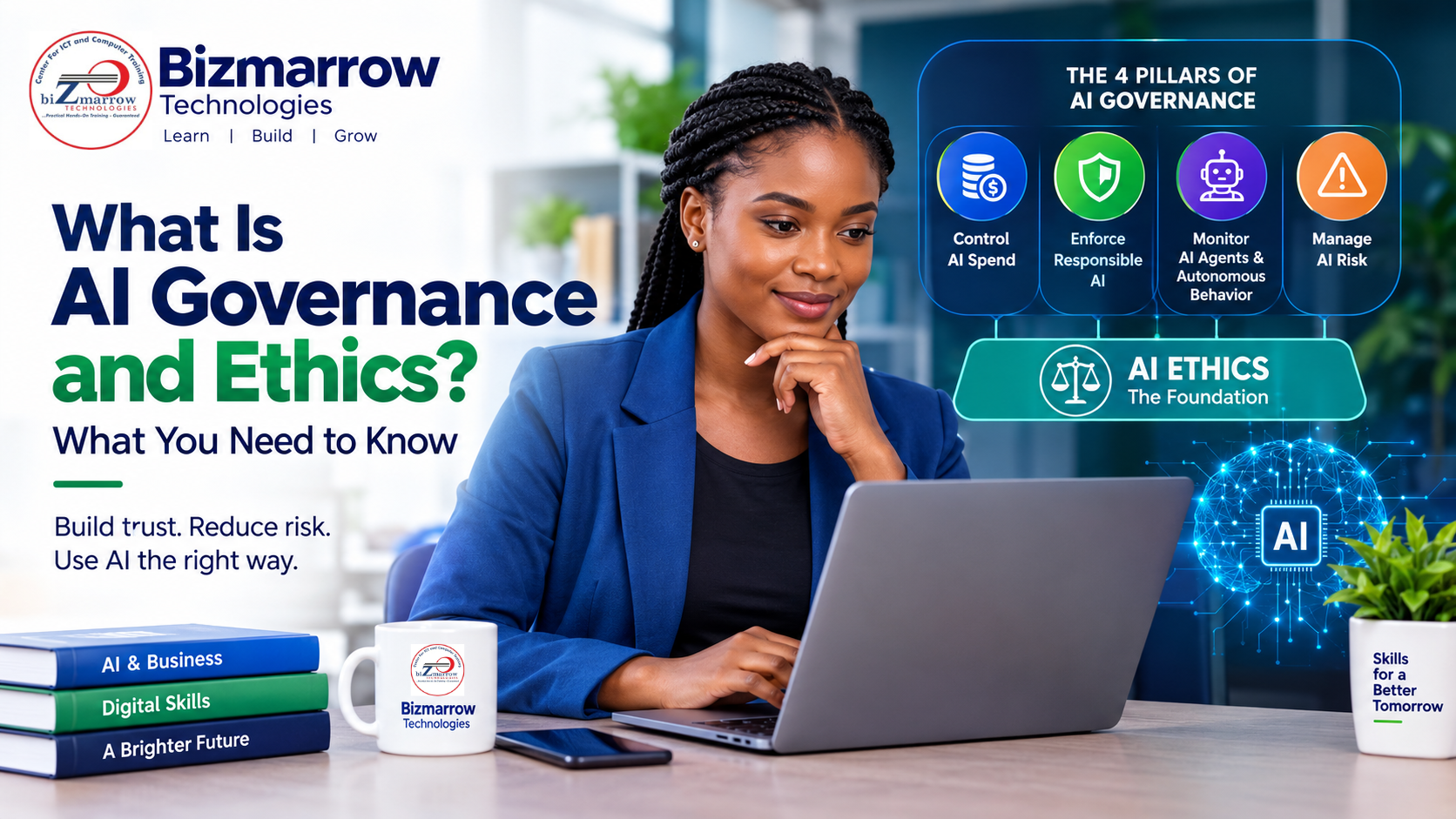
According to guidance from the Scaled Agile Framework, organizations need governance structures capable of dealing with the unpredictability and widespread adoption of generative AI. The framework highlights four important areas: controlling AI spending, enforcing responsible AI, monitoring autonomous AI behavior, and managing AI risks—while placing ethics at the foundation.
What Is AI Governance?
AI governance is the system of policies, rules, processes, controls, responsibilities, and oversight used to ensure that artificial intelligence is developed and used responsibly.
Think of AI governance as the organization’s rulebook for AI.
It helps answer questions such as:
What AI tools are employees allowed to use?
What information can be entered into an AI system?
Who is responsible for an AI-powered decision?
How should sensitive customer or business data be protected?
How much should the organization spend on AI?
When must a human review an AI-generated decision?
How should AI systems be monitored?
What happens when an AI system makes a harmful or incorrect decision?
How can the organization comply with applicable laws and regulations?
Without appropriate governance, organizations may adopt AI faster than they can manage its risks.
What Is AI Ethics?
AI ethics focuses on the moral principles and human values that should guide the development and use of artificial intelligence.
It asks a very fundamental question:
Just because AI can do something, should it do it?
For example, an AI system may be technically capable of making decisions about people. But that does not automatically mean it should make those decisions without human oversight.
AI ethics therefore emphasizes principles such as:
Accountability – people and organizations remain responsible for AI outcomes.
Fairness – AI should not unfairly discriminate against individuals or groups.
Transparency – people should understand when and, where appropriate, how AI is being used.
Trust – AI systems should be reliable and worthy of confidence.
Human oversight – humans should remain involved in important or high-impact decisions.
Privacy and security – personal and sensitive information should be appropriately protected.
Responsibility – organizations should consider the consequences of deploying AI.
AI ethics provides the moral foundation upon which effective AI governance can be built.
Why Is AI Governance Important?
Traditional business controls were not designed for the speed, scale, and unpredictability of modern generative AI.
An employee can now generate reports, analyze data, write software, create marketing materials, summarize documents, or interact with customers using AI within minutes.
AI agents can potentially go even further by taking actions with limited human intervention.
This creates enormous opportunities—but also new risks.
Poorly governed AI can lead to:
Financial waste
Uncontrolled AI expenditure
Data privacy problems
Security vulnerabilities
Biased or discriminatory outcomes
Incorrect information
Regulatory and legal exposure
Reputational damage
Loss of customer trust
Poor business decisions
Uncontrolled actions by autonomous AI systems
Effective governance helps organizations enjoy the benefits of AI while establishing appropriate boundaries around its use.
The goal is not to slow AI down unnecessarily.
The goal is to make sure that moving faster with AI does not mean creating greater risks.
The Four Key Pillars of AI Governance
The Scaled Agile Framework identifies four major areas that organizations should address when establishing AI governance.
1. Controlling AI Spend
AI can introduce new types of technology costs, particularly when organizations use cloud-based AI services or models that charge according to usage.
As AI adoption grows across departments, these costs can quickly become difficult to track.
AI governance should therefore include mechanisms for monitoring:
AI tool usage
AI-related expenditure
Usage-based costs
Departmental consumption
Token or model usage where applicable
The business value generated by AI investments
Organizations should understand where AI money is being spent and whether that spending is producing meaningful value.
For example, a company may discover that one AI application is consuming significant resources without contributing much to business outcomes.
Governance makes such information visible and allows leadership to make better decisions.
2. Enforcing Responsible AI
Responsible AI means using artificial intelligence in ways that are trustworthy, transparent, explainable, human-centered, and consistent with applicable requirements.
Organizations need clear policies governing how AI is used.
For example:
Employees should not simply paste confidential customer information into public AI tools because doing so is convenient.
Instead, organizations should establish rules covering:
Data protection
Privacy
Security
Acceptable AI use
Human review
Transparency
AI-generated content
Model selection
High-impact decisions
Compliance requirements
Responsible AI should become part of normal business processes rather than being treated as a one-time exercise.
3. Monitoring AI Agents and Autonomous Behavior
The rise of AI agents makes governance even more important.
A traditional AI chatbot may generate an answer when a person asks a question.
An AI agent, depending on how it is designed, may be able to perform tasks, interact with systems, make decisions, or initiate actions.
That creates another important question:
What happens when an AI system acts independently?
Organizations need controls that can detect undesirable or unexpected behavior.
These controls can include:
Clearly defined rules
Automated monitoring
Alerts
Activity logging
Permission controls
Human approval for sensitive actions
Limits on what an AI agent can access
Human intervention when necessary
The Scaled Agile guidance emphasizes a combination of deterministic rules, automated detection, and human oversight for monitoring autonomous AI behavior.
The more autonomy an AI system has, the more important appropriate monitoring becomes.
4. Managing and Exploiting AI Risk
AI governance should not be viewed only as a way to prevent problems.
It can also become a source of competitive advantage.
Every new technology introduces risks. The objective is to understand those risks, put appropriate controls in place, and still enable innovation.
For example, instead of every department independently creating its own AI risk assessment process, an organization could develop a shared AI governance system.
This can make future AI projects:
Faster to evaluate
Easier to approve
Less expensive to manage
More consistent
Easier to monitor
In other words, good governance can enable innovation rather than simply restrict it.
AI Ethics Is the Foundation
Governance provides the rules and controls.
Ethics provides the principles behind those rules.
An organization may ask:
“Can we build this AI system?”
But it should also ask:
“Should we build it?”
And:
“What could happen if we deploy it?”
For example, an AI recruitment system might help an organization process thousands of applications quickly.
But if the underlying data contains historical bias, the system could reproduce or amplify that bias.
The technology may work exactly as designed—but the outcome may still be unfair.
That is why AI governance cannot be reduced to technology alone.
It involves people, leadership, data, processes, law, business objectives, and ethical judgment.
Human Accountability Still Matters
One of the most important principles of AI governance is that organizations should not use AI as an excuse to avoid responsibility.
AI can assist people with analysis, recommendations, content generation, automation, and decision support.
But responsibility for important decisions should remain clearly assigned.
Organizations should know:
Who owns the AI system?
Who approved its use?
Who monitors its performance?
Who reviews high-risk decisions?
Who responds when something goes wrong?
Who is accountable for the outcome?
The Scaled Agile Framework similarly emphasizes human accountability and judgment alongside AI-driven execution.
AI may become increasingly autonomous, but accountability should not become automated away.
AI Governance Is Not Only for Large Corporations
Many people assume AI governance is something only multinational companies and large technology organizations need.
That is not true.
Small businesses, startups, schools, financial institutions, healthcare organizations, government agencies, NGOs, and professional service firms are increasingly using AI.
Even a small business should consider questions such as:
Which AI tools are employees using?
Are employees entering customer information into AI systems?
Who owns AI-generated content?
Are AI-generated facts being verified?
Is AI being used to make decisions about employees or customers?
What happens when AI produces incorrect information?
Are staff trained to use AI responsibly?
You do not necessarily need a huge bureaucracy to begin.
You need clear rules, responsible people, appropriate controls, and continuous monitoring.
A Simple AI Governance Framework for Businesses
A practical starting point for an organization can include the following steps.
1. Identify Your AI Use
Create an inventory of the AI tools and systems being used across the organization.
2. Classify the Risks
Not every AI application carries the same level of risk.
Using AI to brainstorm social media ideas is very different from using AI to make decisions involving customers, employees, finances, or sensitive information.
3. Establish AI Policies
Create clear guidelines covering acceptable use, privacy, security, human review, data protection, and accountability.
4. Assign Responsibility
Every important AI system should have someone responsible for its use, monitoring, and outcomes.
5. Protect Your Data
Employees should understand what information can and cannot be entered into AI systems.
6. Monitor AI Performance
AI systems should not simply be deployed and forgotten.
Monitor their accuracy, behavior, costs, security, and business outcomes.
7. Keep Humans in the Loop
For important decisions, establish appropriate human review and approval processes.
8. Review and Improve
AI technology changes rapidly.
Your AI governance policies should therefore evolve as new tools, risks, regulations, and business applications emerge.
AI Governance in the Nigerian Business Environment
For businesses in Nigeria, AI governance is becoming increasingly relevant as organizations adopt AI for marketing, customer service, finance, software development, education, data analysis, recruitment, and operations.
A Nigerian business using AI should think beyond simply asking:
“Which AI tool should we use?”
It should also ask:
“How should we use AI responsibly?”
For example, a business using AI for customer communication should have processes for checking AI-generated information before it reaches customers.
A business using AI to analyze customer data should consider privacy and security.
A company using AI in recruitment should consider fairness and human review.
And a business using multiple AI tools should monitor its overall spending and usage.
AI adoption without governance can create unnecessary risks. AI adoption with appropriate governance can help organizations become more efficient while protecting their customers, employees, reputation, and long-term interests.
AI Governance and the Future of Work
AI is changing the nature of work.
Organizations are increasingly moving from simply using AI as a productivity tool toward building AI-enabled workflows and autonomous systems.
This means AI governance will increasingly become part of everyday business operations.
Employees will need more than the ability to operate AI tools.
They will need to understand:
AI limitations
AI risks
Data privacy
Prompting and AI interaction
Verification of AI outputs
Responsible AI use
Human-AI collaboration
Ethical decision-making
In other words, AI literacy and AI governance will increasingly become important workplace skills.
The Difference Between AI Governance, AI Ethics, and Responsible AI
These concepts are closely related but not identical.
AI Governance is about the structures, policies, controls, responsibilities, and oversight used to manage AI.
AI Ethics is about the values and principles that determine what responsible and acceptable AI use should look like.
Responsible AI is about putting those principles into practice when designing, deploying, and using AI systems.
A simple way to remember the relationship is:
AI Ethics → tells us what is right.
AI Governance → establishes how it will be managed.
Responsible AI → puts those principles into practice.
Why Businesses Should Start Now
AI adoption is moving quickly.
Waiting until an AI-related incident occurs before establishing governance can be expensive.
Organizations that establish clear AI governance early can be better positioned to:
Reduce unnecessary AI costs
Protect sensitive information
Improve trust
Identify risks earlier
Support regulatory compliance
Make AI adoption more consistent
Improve accountability
Encourage responsible innovation
The objective is not to create unnecessary bureaucracy around AI.
It is to create enough structure to allow people and organizations to confidently take advantage of AI.
Final Thoughts
Artificial intelligence is becoming one of the most powerful technologies available to modern organizations.
But powerful technology requires responsible management.
AI governance ensures that organizations have the rules, controls, accountability, and oversight needed to manage AI effectively. AI ethics ensures that those systems remain aligned with human values such as fairness, accountability, transparency, and trust.
The future will not simply belong to organizations that use the most AI.
It will increasingly belong to organizations that know how to use AI effectively, responsibly, safely, and strategically.
At Bizmarrow Technologies, we believe that learning AI should go beyond learning how to use AI tools. Professionals, business owners, students, and organizations need to understand how AI works, how it can create value, its limitations, and the responsibilities that come with using it.
As AI continues to transform the workplace, AI skills, AI literacy, and responsible AI practices will become increasingly important for businesses and professionals in Nigeria and around the world.
Frequently Asked Questions About AI Governance and Ethics
What is AI governance?
AI governance is the system of policies, rules, processes, controls, and responsibilities organizations use to manage artificial intelligence safely, responsibly, and effectively.
What is AI ethics?
AI ethics refers to the principles and values that guide how artificial intelligence should be developed and used, including fairness, accountability, transparency, privacy, and human oversight.
Why is AI governance important?
AI governance helps organizations manage AI-related risks, control costs, protect data, maintain trust, support compliance, and ensure that AI is used responsibly.
What are the main pillars of AI governance?
A useful framework includes controlling AI spending, enforcing responsible AI, monitoring autonomous or agentic behavior, and managing AI risks. AI ethics provides the foundation for these areas.
Does AI governance apply to small businesses?
Yes. Any organization using AI can benefit from basic governance policies covering approved AI tools, data protection, human oversight, responsible use, security, and accountability.
Will AI replace human accountability?
AI may automate many tasks, but organizations still need clear human responsibility for important decisions, risks, and outcomes.
What skills are needed for AI governance?
AI governance requires a combination of AI literacy, cybersecurity awareness, data governance, risk management, business knowledge, ethical reasoning, compliance awareness, and human judgment.