Artificial Intelligence is no longer only a technology issue.
It is becoming a business, government, legal, economic, social, security, and policy issue.
As organizations, governments, schools, financial institutions, and businesses increasingly adopt AI, there is a growing need for professionals who can help answer important questions:
What should AI be allowed to do?
What rules should govern its use?
How can organizations use AI while protecting people, data, businesses, and society?
This is where an AI Policy Analyst comes in.
An AI Policy Analyst works at the intersection of artificial intelligence, public policy, regulation, risk, ethics, business, and society. Their job is to understand how AI is developing, identify its opportunities and risks, study existing and emerging policies, and help organizations or governments make informed decisions about AI.
As AI adoption grows, AI policy is becoming an increasingly important career area for people who are interested in technology but do not necessarily want to become software engineers or data scientists.
What Is an AI Policy Analyst?
An AI Policy Analyst is a professional who researches, evaluates, develops, and communicates policies and recommendations relating to artificial intelligence.
They may work for:
Government agencies
Technology companies
Banks and financial institutions
Consulting firms
Universities and research institutions
International organizations
Non-governmental organizations
Think tanks
AI companies
Legal and compliance organizations
Corporate risk and governance teams
An AI Policy Analyst may study questions involving AI regulation, privacy, algorithmic bias, AI safety, cybersecurity, responsible AI, economic impact, employment, intellectual property, human rights, or the use of AI in particular industries.
In simple terms:
An AI Policy Analyst helps people and organizations understand what AI means for society and what rules, policies, and safeguards may be needed.
What Does an AI Policy Analyst Actually Do?
The exact responsibilities vary depending on the organization.
However, an AI Policy Analyst may spend their time doing several different types of work.
1. Researching AI Policies and Regulations
AI policy is changing rapidly.
An analyst may monitor new legislation, regulatory proposals, government strategies, standards, industry policies, and international developments.
They may ask:
What new AI regulations are being proposed?
How could a new regulation affect businesses?
What obligations could organizations have?
What risks could arise from a particular AI application?
How are different countries approaching AI?
What policies could encourage innovation while reducing harm?
The analyst then turns complex information into useful recommendations for decision-makers.
2. Analyzing AI Risks
AI systems can create benefits, but they can also introduce risks.
An AI Policy Analyst may assess issues such as:
Privacy
Security
Bias and discrimination
Misinformation
Transparency
Accountability
Intellectual property
Employment impacts
Safety
Consumer protection
Autonomous AI behavior
Data governance
The goal is not necessarily to stop organizations from using AI.
Instead, the goal is to help organizations understand and manage AI risks while still taking advantage of the technology.
The U.S. National Institute of Standards and Technology (NIST), for example, describes AI risk management as an ongoing process intended to help organizations manage risks and promote trustworthy and responsible AI.
3. Developing AI Policies
An AI Policy Analyst may help an organization create policies that explain how employees and teams should use AI.
For example, a company might need an internal policy covering:
“Acceptable Use of Generative AI in the Workplace.”
The policy could address:
Which AI tools employees may use
What company information can be entered into AI systems
How confidential information should be handled
When human review is required
How AI-generated content should be checked
How AI-related incidents should be reported
Who is responsible for AI systems
Good AI policies turn broad principles into practical rules employees can follow.
4. Monitoring AI Regulations
AI regulations can differ between countries and industries.
An AI Policy Analyst may monitor developments across multiple jurisdictions and determine how they could affect an organization.
For an international company, this can become especially important because an AI system may be developed in one country, operated in another, and used by customers around the world.
The analyst therefore needs to understand not only technology but also policy environments and regulatory differences.
5. Writing Reports and Policy Briefs
Communication is one of the most important skills in this career.
AI Policy Analysts may produce:
Policy briefs
Research reports
Regulatory summaries
AI governance documents
Risk assessments
Executive briefings
Position papers
Consultation responses
Internal AI policies
Recommendations for management
The ability to take a complicated AI issue and explain it clearly to a non-technical audience is extremely valuable.
6. Advising Decision-Makers
Senior executives, government officials, policymakers, lawyers, product managers, and other decision-makers may not have time to follow every development in AI.
An AI Policy Analyst can help them understand:
What happened?
Why does it matter?
What are the risks?
What are the opportunities?
What should we do next?
This makes the role both analytical and advisory.
AI Policy Analyst vs AI Engineer
These careers are related to AI but require different types of work.
An AI Engineer focuses primarily on building and implementing AI systems.
An AI Policy Analyst focuses primarily on understanding and shaping the policies, rules, risks, and societal implications surrounding AI.
For example:
AI Engineer:
“How can we build this AI system?”
AI Policy Analyst:
“Should this AI system be used for this purpose, what risks could it create, and what rules or safeguards should apply?”
Both roles are important.
As AI becomes more widely deployed, organizations need people who can build AI and people who can help ensure that it is deployed responsibly.
What Skills Does an AI Policy Analyst Need?
You do not necessarily need to be an advanced programmer to work in AI policy.
However, you need a strong understanding of technology and the ability to connect technical issues with policy and real-world consequences.
Here are some of the most valuable skills.
1. AI Literacy
You should understand the fundamentals of:
Artificial intelligence
Machine learning
Generative AI
Large language models
AI agents
Data
Algorithms
Automation
AI limitations
You do not necessarily need to build neural networks from scratch.
But you should understand enough about AI to ask intelligent questions about how systems work and where they can fail.
2. Research Skills
AI policy involves a lot of research.
You may need to read:
Laws
Regulations
Government publications
Technical reports
Research papers
Industry standards
Corporate policies
Academic studies
Consultation documents
You need to know how to find reliable information, evaluate sources, compare evidence, and identify important trends.
3. Analytical Thinking
An AI Policy Analyst needs to look beyond the obvious.
For example:
An organization wants to introduce an AI recruitment system.
The analyst should not simply ask:
“Will the system save money?”
They may also ask:
Could the system introduce bias?
What data is being used?
How accurate is the system?
What happens when it makes a mistake?
Can applicants challenge decisions?
Who is accountable?
What privacy issues exist?
What human oversight is required?
This ability to examine a problem from multiple perspectives is essential.
4. Policy and Regulatory Knowledge
A strong AI Policy Analyst should understand how policies and regulations work.
Depending on their area of specialization, they may study:
Data protection
Privacy
Cybersecurity
Consumer protection
Employment law
Intellectual property
Technology regulation
Digital rights
AI governance
Risk management
You do not have to become a lawyer to start learning AI policy.
However, understanding how laws, regulations, standards, and organizational policies interact can be extremely valuable.
5. Communication Skills
An AI Policy Analyst may communicate with engineers one day and executives or policymakers the next.
You therefore need to explain technical and policy concepts in clear language.
Strong writing is particularly important.
If you cannot communicate your analysis clearly, even excellent research may have little impact.
6. Critical Thinking
AI produces impressive results, but it can also produce incorrect, incomplete, biased, or misleading information.
An AI Policy Analyst should not automatically accept AI-generated information.
They need to question assumptions, verify evidence, identify gaps, and understand uncertainty.
7. Ethical Reasoning
AI policy often involves difficult questions about what is fair, acceptable, responsible, or harmful.
Professionals in this field should understand concepts such as:
Fairness
Accountability
Transparency
Privacy
Human oversight
Safety
Explainability
Non-discrimination
These principles are central to responsible AI.
Do You Need a Degree to Become an AI Policy Analyst?
There is no single degree that guarantees a career as an AI Policy Analyst.
People can enter the field from different academic and professional backgrounds.
Relevant backgrounds can include:
Computer Science
Information Technology
Data Science
Law
Public Policy
Political Science
Economics
International Relations
Philosophy
Ethics
Cybersecurity
Business
Public Administration
Social Sciences
What matters is the combination of AI knowledge + policy understanding + analytical ability + communication skills.
Someone with a technology background can develop policy expertise.
Someone with a policy or legal background can develop AI and technical literacy.
This makes AI policy an interesting interdisciplinary career.
Career Opportunities in AI Policy
AI Policy Analyst is only one possible career path.
As organizations build AI governance capabilities, related roles are emerging across different industries.
Here are some career areas worth exploring.
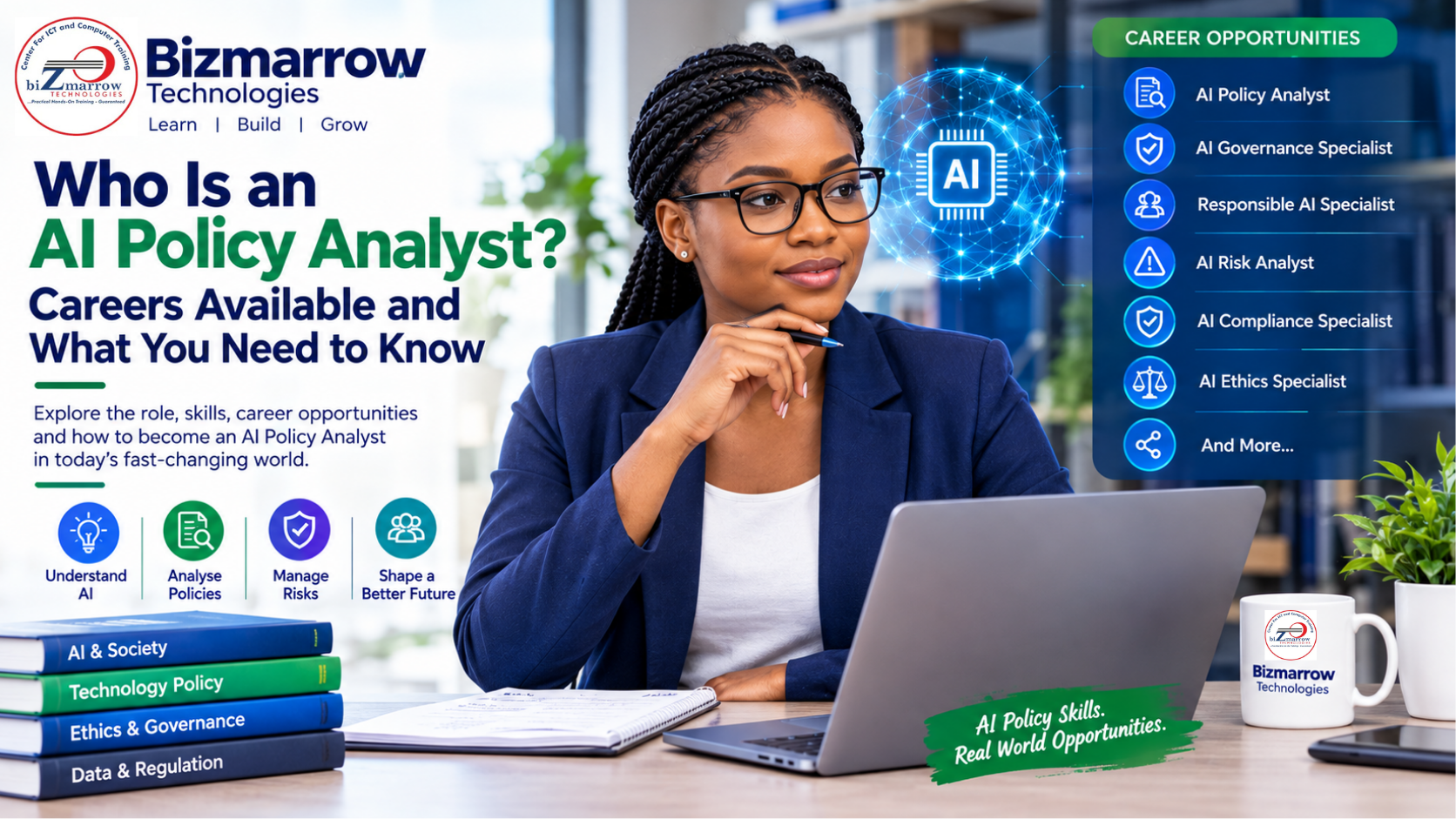
1. AI Policy Analyst
This is the most direct career path.
You research AI policy issues, monitor regulations, analyze risks, and develop recommendations.
2. AI Governance Specialist
An AI Governance Specialist helps organizations establish processes and controls for responsible AI use.
Their work may involve:
AI policies
Governance frameworks
Risk assessments
AI inventories
Documentation
Accountability
Monitoring
3. Responsible AI Specialist
This role focuses on ensuring that AI systems are developed and used according to responsible AI principles.
The work can involve fairness, transparency, safety, accountability, privacy, and human oversight.
4. AI Risk Analyst
AI Risk Analysts focus on identifying, assessing, and managing risks associated with AI systems.
They may work alongside cybersecurity, compliance, legal, audit, and enterprise risk teams.
5. AI Compliance Specialist
As organizations face more AI-related legal and regulatory requirements, compliance professionals can specialize in helping businesses understand and meet those obligations.
6. AI Ethics Specialist
AI Ethics Specialists focus on the ethical implications of AI systems and help organizations make decisions that align technology development with human values and responsible practices.
7. AI Governance Consultant
Consultants can help different organizations develop AI governance strategies, policies, risk frameworks, and implementation processes.
This can be an attractive career path for professionals who enjoy working with multiple businesses and industries.
8. Technology Policy Researcher
Technology Policy Researchers study how technological developments affect society, government, businesses, and individuals.
AI can be one specialization within a broader technology-policy career.
9. AI Regulatory Affairs Specialist
Regulatory affairs professionals monitor regulatory developments and help organizations understand and respond to regulatory requirements affecting AI products and services.
10. AI Program or Governance Manager
As organizations develop larger AI programs, they may need managers who coordinate AI governance, policy, risk, compliance, technology, and business teams.
Where Can AI Policy Professionals Work?
AI policy is not limited to government.
Potential employers and sectors include:
Government
Government agencies need professionals who understand AI policy, regulation, digital transformation, risk, and public-sector technology.
Technology Companies
AI companies and technology firms need professionals who can help them navigate regulation, responsible AI, public policy, and governance.
Banks and Financial Institutions
Financial organizations use AI for fraud detection, customer service, credit decisions, risk management, and other activities.
This creates a need for professionals who understand both AI and financial-sector governance.
Consulting Firms
Consulting organizations can employ AI governance, risk, policy, compliance, and responsible-AI professionals to advise clients.
Universities and Research Institutions
Research organizations and universities may employ professionals working on AI governance, technology policy, ethics, and the social implications of AI.
NGOs and Think Tanks
AI policy researchers may work on issues involving digital rights, technology access, AI safety, public policy, development, and social impact.
International Organizations
AI policy is increasingly international.
Professionals may work on cross-border technology policy, standards, digital governance, economic development, and AI cooperation.
AI Policy Careers in Nigeria
For Nigerians, AI policy is an emerging area with opportunities across both the public and private sectors.
As Nigerian organizations increasingly adopt AI for banking, fintech, education, healthcare, telecommunications, marketing, customer service, cybersecurity, government services, and business operations, there will be a growing need for professionals who understand how AI should be governed.
Potential areas include:
AI governance in banks and fintech companies
Technology policy
Data protection and privacy
Digital transformation
AI compliance
Cybersecurity policy
Responsible AI
Public-sector AI policy
AI risk management
Technology consulting
AI research
Digital rights and policy advocacy
The opportunity is particularly interesting for professionals who can combine AI knowledge with business, law, policy, cybersecurity, data, or governance expertise.
What Tools Should an AI Policy Analyst Know?
An AI Policy Analyst should become comfortable with modern research and productivity tools.
These can include:
Generative AI assistants
Research databases
Document analysis tools
Spreadsheet software
Data visualization tools
Policy and regulatory databases
Collaboration platforms
Presentation software
Knowledge-management tools
AI itself can also become a productivity tool for policy research.
However, AI-generated information should be verified against reliable primary sources before being used in professional policy work.
This is particularly important because an AI system can confidently produce inaccurate information.
How to Become an AI Policy Analyst
If you are interested in this career, you can start building your skills step by step.
Step 1: Learn AI Fundamentals
Start with the basics of:
AI
Machine learning
Generative AI
Large language models
AI agents
Data
Automation
AI risks and limitations
You do not need to become an AI engineer before starting.
Step 2: Learn AI Governance
Understand concepts such as:
AI governance
AI ethics
Responsible AI
AI risk management
AI accountability
AI transparency
Human oversight
Data governance
Frameworks such as the NIST AI Risk Management Framework provide useful material for understanding how organizations can identify and manage AI risks.
Step 3: Develop Policy and Research Skills
Learn how to:
Conduct policy research
Analyze regulations
Compare policies
Write policy briefs
Summarize complex documents
Evaluate evidence
Make recommendations
Step 4: Choose a Specialization
You can specialize in an area such as:
AI + Law
AI + Cybersecurity
AI + Finance
AI + Healthcare
AI + Education
AI + Government
AI + Business
AI + Human Rights
AI + Data Privacy
Your specialization can make you more valuable to employers.
Step 5: Build a Portfolio
Do not rely only on certificates.
Create practical work that demonstrates what you can do.
For example, you could create:
An AI policy brief
An AI governance policy for a fictional company
An AI risk assessment
A comparison of AI regulations in different countries
An AI ethics case study
A responsible AI checklist
An analysis of how AI could affect a Nigerian industry
A strong portfolio can demonstrate your thinking and communication skills to potential employers.
Step 6: Develop Strong AI Literacy
Use AI tools yourself.
Understand their strengths and limitations.
Experiment with generative AI, research tools, document analysis, data tools, and AI productivity platforms.
The best AI policy professionals will not only study AI from a distance.
They will understand how people and organizations actually use it.
AI Policy Analyst: Is It a Good Career?
AI policy can be an attractive career for people who enjoy technology but also enjoy research, writing, business, law, government, ethics, or strategic thinking.
You do not have to spend your entire career writing code.
Instead, you can work on questions surrounding the development and deployment of AI.
The field can also provide opportunities to work across industries because AI is becoming relevant to almost every sector.
However, it is important to understand that AI policy is a relatively evolving career field.
Job titles, responsibilities, regulations, and required skills can change as AI technology and governance practices develop.
That means continuous learning is essential.
The Future of AI Policy Careers
AI is moving from simple automation and chatbots toward increasingly capable AI systems and AI agents.
As these systems become more deeply integrated into organizations, questions about accountability, safety, privacy, regulation, risk, and responsible use will become increasingly important.
Organizations will need professionals who can bridge the gap between:
Technology + Business + Government + Law + Society
That is one of the reasons AI policy is becoming an important emerging career field.
The future will need people who understand not only how AI works, but also how AI should be used.
An AI Policy Analyst is more than someone who reads technology regulations.
The role requires the ability to understand AI, investigate its opportunities and risks, interpret policies, think critically, communicate clearly, and help organizations or governments make responsible decisions.
For students, graduates, technology professionals, lawyers, business professionals, researchers, cybersecurity specialists, and policy enthusiasts, AI policy can provide a pathway into the rapidly growing AI economy without requiring a purely technical career.
The most valuable professionals may increasingly be those who can speak both languages:
the language of technology and the language of policy.
At Bizmarrow Technologies, we believe that preparing for the AI economy requires more than learning how to use AI tools. Professionals need practical digital skills, AI literacy, critical thinking, business understanding, and the ability to understand how technology affects real-world organizations and careers.
As artificial intelligence continues to transform industries, learning about AI governance, AI ethics, AI policy, and responsible AI can help you position yourself for emerging opportunities.
Frequently Asked Questions About AI Policy Analysts
What is an AI Policy Analyst?
An AI Policy Analyst researches and analyzes policies, regulations, risks, ethical issues, and societal impacts relating to artificial intelligence and provides recommendations to organizations, governments, or other stakeholders.
Is an AI Policy Analyst a technical job?
It can involve technical knowledge, but it is not necessarily a programming-heavy career. AI Policy Analysts need strong AI literacy, research, analytical, policy, communication, and critical-thinking skills.
What degree do I need to become an AI Policy Analyst?
There is no single required degree. Relevant backgrounds can include computer science, information technology, law, public policy, political science, economics, cybersecurity, business, international relations, and social sciences.
Can a programmer become an AI Policy Analyst?
Yes. A technology professional can build policy, governance, risk, ethics, and regulatory knowledge and transition into AI policy.
Can a lawyer become an AI Policy Analyst?
Yes. Legal professionals with strong AI and technology knowledge can pursue careers in AI regulation, AI compliance, responsible AI, technology policy, and AI governance.
What is the difference between an AI Policy Analyst and an AI Governance Specialist?
An AI Policy Analyst may focus more heavily on researching and analyzing policies, regulations, and broader societal issues. An AI Governance Specialist typically focuses more on implementing organizational policies, controls, processes, accountability, and AI risk-management practices. The responsibilities can overlap considerably.
What skills are most important for an AI Policy Analyst?
Important skills include AI literacy, research, critical thinking, policy analysis, regulatory awareness, risk assessment, ethics, communication, report writing, and stakeholder management.
Can I work in AI policy without knowing how to code?
Yes. Coding can be useful, particularly for understanding technical systems and analyzing data, but many AI policy roles are centered on research, governance, regulation, risk, ethics, communication, and strategy.
Is AI policy a good career in Nigeria?
AI policy is an emerging field in Nigeria and globally. As organizations increasingly adopt AI, opportunities can develop across technology, banking, fintech, consulting, government, cybersecurity, data protection, education, research, and other sectors.
What should I learn first if I want to enter AI policy?
Start with AI fundamentals, then learn AI governance, AI ethics, responsible AI, AI risk management, policy research, and regulatory analysis. Build practical projects that demonstrate your knowledge rather than relying only on certificates.